
Looking at Audi’s new cars, I noticed their implementation of digital side mirrors. To put it mildly, it looks like a hammerhead shark driving down the road.
The image below shows the digital side mirror appearance resulting from the auto industry’s insistence on inheriting traditional mirror placement thinking—it looks like king oyster mushrooms sprouting from both sides of the car frame.
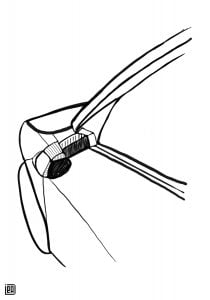 Audi Digital Side Mirror
Before the 1970s, many car side mirrors were mounted on the front fenders near the headlights. Over the following decades, mounting them on the front doors near the A-pillar became the mainstream standard.
However, despite advancements in camera technology, automakers simply replaced traditional reflective glass with camera lenses and slightly slimmed down the profile while retaining the protruding arm structure.
Given that image capture relies entirely on camera sensors now, this forced protruding mirror stalk is completely unnecessary. Moreover, these digital mirrors still retain blind spots and, by removing the driver’s need to turn their head significantly, may even induce fatigue and compound driving risks.
Below are a few redesign solutions that modify the exterior vehicle structure directly, renaming the Electronic Rear Mirror to Electronic Surround View-cam (ESV).
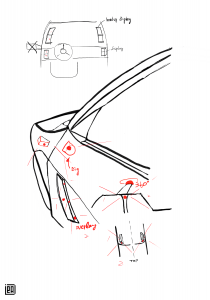 Electronic Surround View-cam (ESV) Improvement Concept
This improved electronic surround view system could embed cameras flush into non-structural door cutouts, integrate camera bumps into the fenders, or even position a 360-degree surround camera unit on the roof.
Please note that these specific camera placement points (red dots) have not undergone practical engineering validation. Although theoretical logic suggests zero-blind-spot coverage, actual implementation would require validation by automotive engineers.